What is pay per call? How it works, from the call to the payout
Pay per call is an advertising model where a business pays for each qualified phone call, instead of paying for each click. A qualified call is one that meets rules agreed before the campaign starts.
This guide follows one call from the ad to the money. It also covers who pays whom, and what happens when a call doesn't count.
What is pay per call advertising?
Pay per call advertising, also called pay per call marketing, is a kind of performance marketing. In performance marketing, a business pays only when a specific result happens.
Here, the result is a real phone call from a real consumer. An impression or a click doesn't count.
The call also has to meet the agreed rules. They might set a minimum call length, a location and the hours someone can answer.
Why a call is worth more than a click
A click takes a second, and it can be curiosity or an accident. A call means someone stopped what they were doing and chose to talk to a person.
That usually shows stronger intent, though not in every case. It's why buyers are generally willing to pay more for a call than for a click.
A lead sits between the two. A lead is someone who filled out a form, and the business still has to reach them.
The four parties: consumer, publisher, buyer, network
- Consumer. The person who makes the call, often after seeing an ad or a web page.
- Publisher. The party that creates the reason for the call, through an ad, a page, an email or a video. You'll also hear affiliate or seller. TrackDrive's help center says traffic source.
- Buyer. The business that receives the call and pays for it, such as a call center, law firm or agency. You'll also hear advertiser.
- Network. An optional company in the middle. It bills the buyer, pays the publisher and keeps the difference.
A pay-per-call network is a business. A platform is the software that tracks and routes the calls, and TrackDrive is a platform.
How does pay per call work? One call, start to finish
Five steps run in order. The first four usually happen within a few seconds, and the last runs when the call ends.
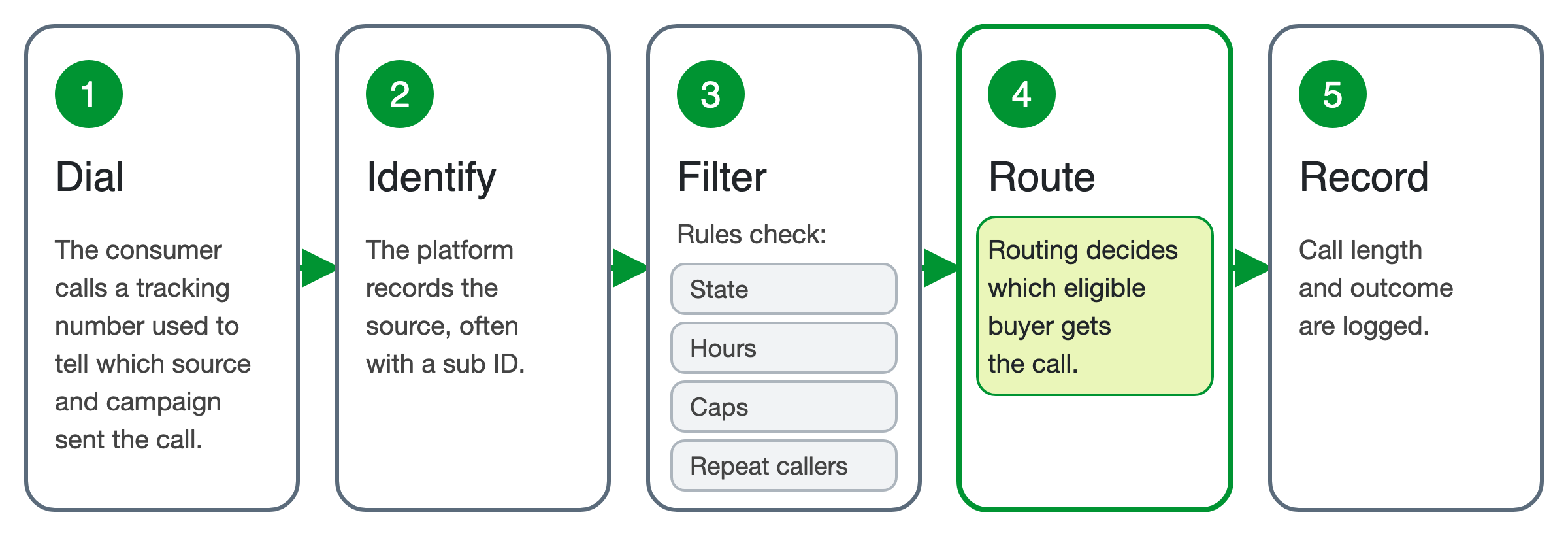
1. Dial. The consumer calls a tracking number, a phone number used to tell which source and campaign sent the call. On a website, dynamic number insertion can show each visitor a different number.
2. Identify. The platform records the source, often with a sub ID. A sub ID is an extra tag that says which ad, page or placement sent the traffic.
3. Filter. Rules check whether the call is eligible: the caller's state, the buyer's hours, its caps and any repeat callers. In TrackDrive, buyers that are closed, paused, at their caps or concurrency limits, or excluded by your filters are skipped.
4. Route. Routing decides which eligible buyer gets the call. In TrackDrive, each buyer is ranked by priority, by its current bid or by earnings per call, depending on its settings.
Ping-post is one more way to pick a buyer: bids are collected before the call connects. They come live from some buyers and at a fixed price from others.
The best eligible buyer gets the call, and that depends on each buyer's ranking method.
5. Record. The platform logs how long the call lasted and how it ended. The call may also be recorded, where that's allowed and properly disclosed.
A disposition is the outcome an agent or the system assigns after a call, such as "not qualified" or "left a voicemail".
What makes a call qualified
A call is qualified when it meets every rule in the deal. The rules are set deal by deal, so there's no standard list. These are the common ones.
- Billable duration. The minimum talk time before a call becomes payable. In an invented example with a 60-second minimum, a 40-second call fails and a 90-second call passes. <!-- sweep-ok: invented example -->
- Location. The caller is somewhere the buyer serves. In insurance and lending, a buyer may be licensed only in certain places.
- Hours. The call arrives when someone is there to answer.
- Repeat callers. A call from the same person inside an agreed window may not count.
Get those rules in writing before any traffic runs: how long, from where and at what times. Otherwise you may first learn you disagree when the invoice arrives.
In TrackDrive, a buyer conversion is the rule that says a call counts. Most often it's a minimum number of connected seconds.
The buyer can also report a conversion by postback, a server-to-server message saying a call converted.
The publisher's payout follows its own conversion rules, which can follow the buyer's conversion.
Two limits sit beside those rules. A cap limits how much a buyer takes in a set period or in total. Concurrency is how many calls it can hold at once.
How the money moves: revenue, payout and margin
Revenue is what the buyer pays for a call. Payout is what the publisher earns for it. Margin is revenue minus payout, the part a network keeps.
Here's an example with invented numbers, not benchmarks. A publisher sends 100 calls and 80 qualify. <!-- sweep-ok: invented example -->
In this invented deal, the buyer pays $50 per qualified call, and the publisher earns $35. <!-- sweep-ok: invented example -->
In this invented example, revenue is $4,000 and payout is $2,800. Margin is $1,200, or 30% of revenue. <!-- sweep-ok: invented example -->
Now pay the publisher on all 100 calls at the same invented rate. Payout becomes $3,500, and margin falls to $500, or 12.5% of revenue. <!-- sweep-ok: invented example -->
The rates didn't change. What changed is what the payout was based on, so always ask whether it's paid on qualified calls or on all calls.
Network or direct: who pays whom
The calls flow one way, and the money flows back the other way. Who handles that money depends on the deal.
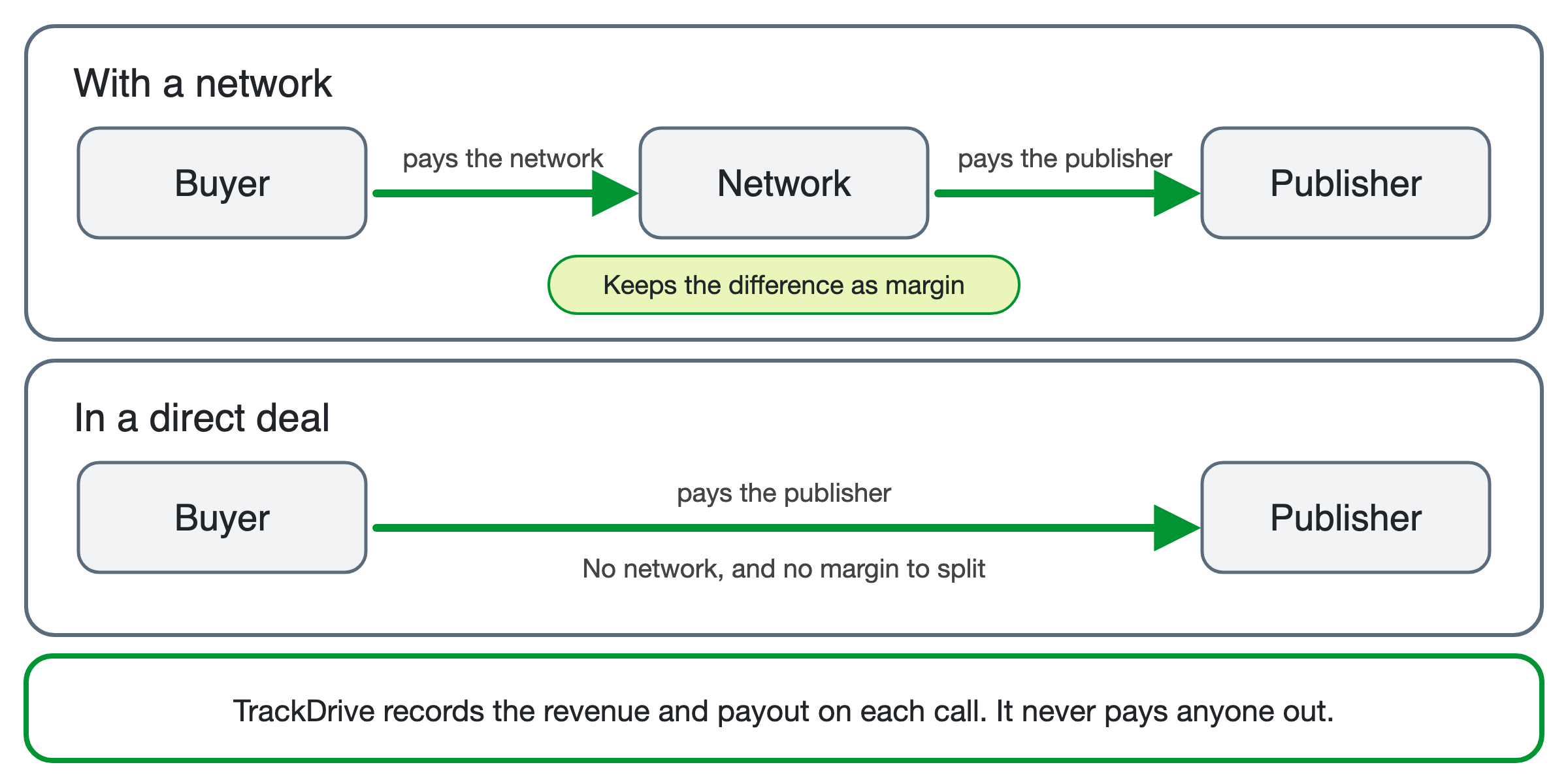
With a network, the buyer pays the network and the network pays the publisher. The network keeps the difference as its margin, and each side deals with one company.
In a direct deal, there's no network. The buyer pays the publisher, and there's no margin to split. The two of you agree the terms and handle your own invoices.
TrackDrive isn't the one moving the money in either setup. It records the revenue and payout on each call. TrackDrive tracks earnings; it never pays anyone out.
So a direct deal needs payment terms in writing: when invoices go out, when they're due and how disputes are settled.
When a call doesn't count: scrubs and disputes
Not every call earns money. What happens next depends on when the problem shows up.
The call never met the rules. It ended before the billable duration, say. In TrackDrive, a call shorter than a duration rule's seconds doesn't fire that rule, and revenue is applied when a conversion fires.
The call failed a later check. A scrub is removing or disputing a call that fails the agreed rules. If a buyer finds a call came from a state outside the agreement, it can scrub it, and that call isn't paid.
"Scrub" has a second meaning, about Do Not Call lists.
The two sides disagree. The dispute window is how long a buyer has to dispute a call after it happens. A long window means more risk for whoever is paying out.
Settle it with evidence, not opinions. On a recorded call, you can review just the segment a dispute is about.
On offers where it's turned on, AI call scoring grades each transcribed call against your own scorecard. That lets you check more calls than you could hear.
In a direct deal, your written agreement is what settles payment. Make sure it says how scrubs and rejected calls are handled.
A fair dispute runs in order: contain the source, gather the facts, ask in writing, decide, and write it down.
Is pay per call legit?
Yes, as a model. A given deal is legit when the rules are agreed first, every call is tracked to its source, and consent and compliance are handled.
US federal law uses "pay-per-call services" for lines reached through a 900 number or another designated prefix or area code.
There, "the caller pays a per-call or per-time-interval charge" above the cost of carrying the call (16 CFR 308.2). In pay per call advertising, the business pays for the call.
These are signs of a bad deal:
- Nobody will define a qualified call in writing.
- A publisher can't show you a live ad or page, or is vague about how it gets calls.
- Two publishers share one tracking number, so nobody can say who earned the call.
- The agreement has no dispute window or payment date.
This section is general education, not legal advice. Rules differ by state and industry and change often, so confirm them with qualified counsel before you launch.
In pay per call, the consumer usually makes the call. Outbound follow-up to someone who filled out a form is different.
A marketing call placed with an autodialer or an artificial or prerecorded voice generally needs documented consent. That consent should name the business (47 CFR 64.1200).
Some states require everyone on a call to agree to a recording, so a short disclosure at the start is a safe habit. Check national and state do-not-call lists before you reach out.
TrackDrive has suppression lists and do-not-contact checks. It doesn't pre-check leads against the federal Do Not Call registry, so scrub your lists before import.
These tools help you run an outbound program, but they "do not, on their own, guarantee compliance."
Which industries buy calls
Calls suit purchases where people have questions or want reassurance. Insurance, home services, legal help, financial products and healthcare are the usual examples.
What is pay-per-call plumbing?
Pay-per-call plumbing means a plumbing company buys phone calls from people who need a plumber. The plumber is the buyer.
The rules are local. In an invented example, a two-person crew takes calls only from named zip codes, only at set hours, and only two at a time. Emergency work can make night hours matter too.
In TrackDrive, a zip code list is a named collection of US zip codes used for geographic targeting. A 7-day by 24-hour grid sets when each buyer is eligible, and a concurrency cap sets the most live calls it can hold.
Starting out in pay per call
Pick your seat first. A publisher generates calls, a buyer answers them, and a network connects the two.
How to start a pay per call business
Settle six things before you launch: offer terms, buyers, routing, compliance, tracking and test calls. Test calls are the step most often skipped.
Place real calls yourself, start to finish. Check that each one is tracked, routed, answered, timed and recorded as you expect.
How to find pay per call clients
Whether a buyer comes through a network or directly, ask six things first. Ask what a qualified call is, their hours and staffing, and their capacity.
Then ask about geography and licensing, payment terms and the dispute window, and compliance requirements.
Before you approve a publisher, ask how it generates calls and ask to see a live ad or page. Ask which verticals it has worked, and whether it has had complaints.
How to run a pay per call campaign
Watch four numbers every week, by publisher and by sub ID: qualified rate, billable rate, revenue per call and margin. When one drops, check traffic, then routing, then the buyer, then pricing.
Change one thing at a time.
What a pay-per-call platform does
TrackDrive is call tracking and lead-to-call automation for performance marketers. It records where each call came from, and decides in real time which buyer, if any, gets it.
It also checks whether the call converted and records the revenue and payout.
Not every account is a marketplace. A company running its own call center can use buyers to stand for its own queues, regions or teams.
Inbound calls on TrackDrive have a per-minute rate, billed as you go, and each tracking number has a monthly rate. There's no onboarding fee. See TrackDrive pricing.
Questions people ask
Does the platform pay the publisher? Not on TrackDrive. It tracks earnings and never pays anyone out. With a network, the network pays the publisher. In a direct deal, the buyer does.
How long does a call have to last? As long as the deal says. Billable duration is set deal by deal, so no single length is standard.
How much does a pay-per-call call pay? That's set per deal and per vertical, so this guide gives no benchmark. The rate also tells you little without the rules for which calls count.
Is pay per call the same as pay per click? No. Pay per click charges for a click, and pay per call charges for a qualified call. "PPC" usually means pay per click, so it's clearer to spell out pay per call.
Do I need a website to do pay per call? No. A tracking number can go on any ad or offline placement. If you do use a website, dynamic number insertion can tie each call to the visit.
See it in action
Request a demo for a live walkthrough tailored to your use case, or start free, with no credit card and no onboarding fee.