Pay-per-call networks: how they work, where the platform fits
A pay per call network is a business that sits between the companies that buy phone calls and the publishers who generate them. It bills the buyer, pays the publisher and keeps the difference.
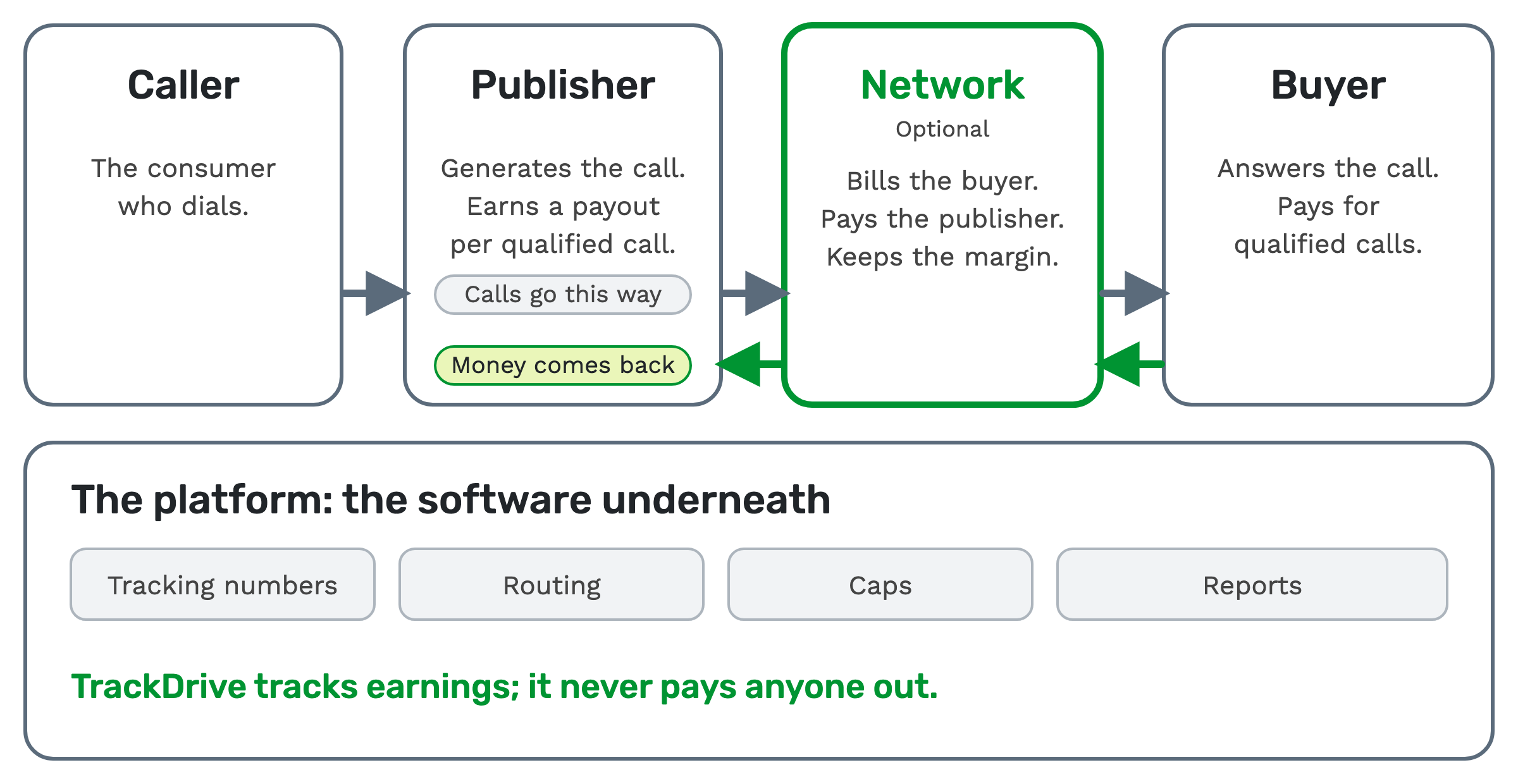
The software it runs on is a separate thing, called the platform. TrackDrive is a platform, not a network. TrackDrive tracks earnings; it never pays anyone out.
The four parties in a pay per call network
Pay per call is advertising where a business pays for each qualified phone call. A qualified call is one that meets rules agreed in advance.
- The caller is the consumer who dials.
- The publisher, or affiliate, is who generates the call. It runs the ad, page, email or video that makes someone dial.
- The network sits in the middle. It's optional: not every campaign has one.
- The buyer, or advertiser, is the business that answers the call and pays for it.
A network is convenient because each side deals with one company. The network handles the billing and the payments.
How money moves through a network
Calls travel from the publisher to the buyer. Money travels the other way, and with a network it passes through the network.
Three numbers describe every deal.
- Revenue is what the buyer pays for a call.
- Payout is what the publisher earns for it.
- Margin is revenue minus payout. It's what the network keeps.
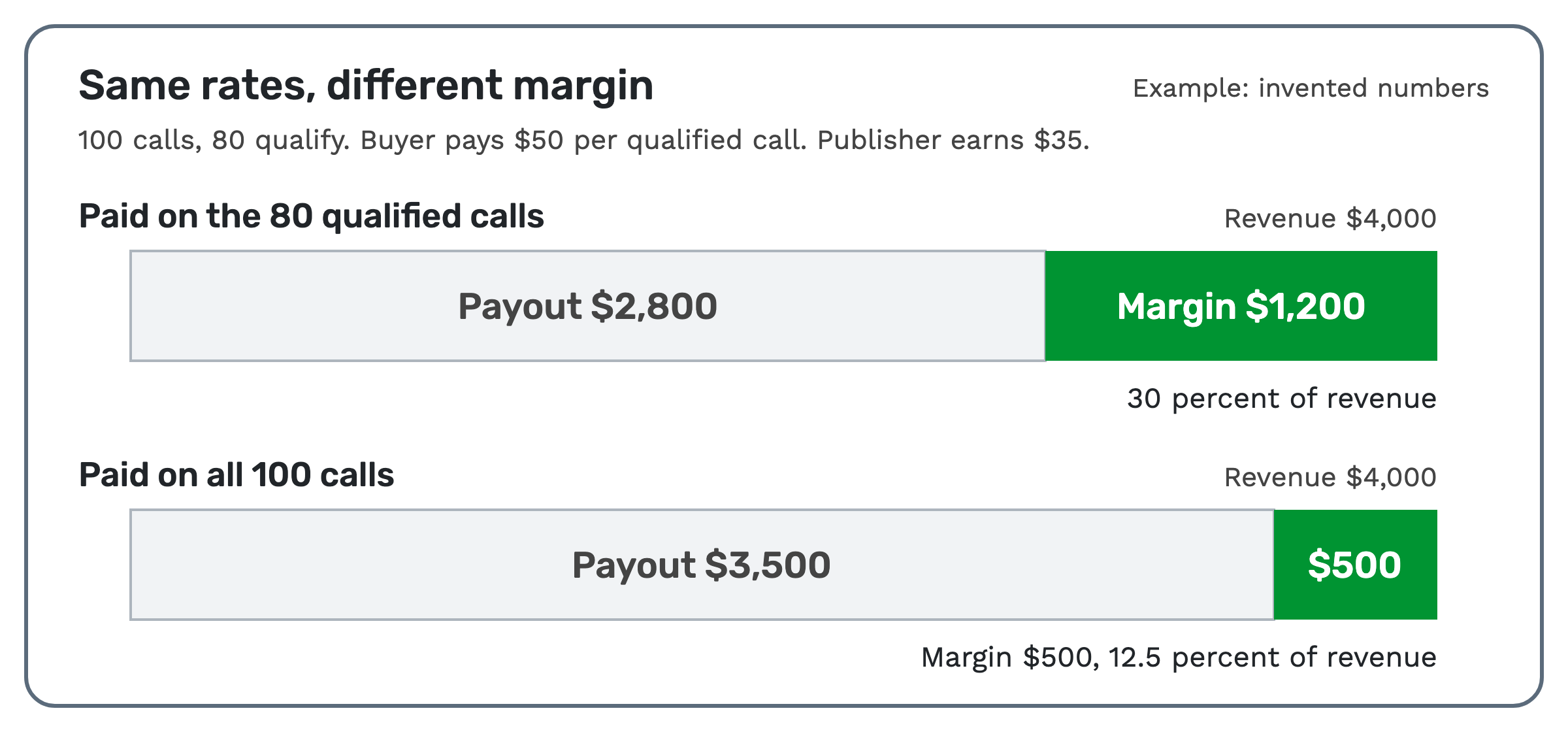
Here's an invented example, not real campaign data. A network handles 100 calls and 80 qualify.
In this example, the buyer pays $50 for each qualified call, and the publisher earns $35.
That invented campaign brings in $4,000 of revenue and $2,800 of payout. The margin is $1,200, or 30 percent of revenue.
Now suppose the network had paid the publisher on all 100 calls. In the example, payout rises to $3,500 and revenue stays at $4,000, because the buyer pays only for qualified calls.
The example's margin falls to $500, or 12.5 percent.
The rates didn't change. What changed is which calls the payout was based on.
 Timing matters too. If a network pays its publishers before its buyers have paid it, the network covers the gap.
A dispute window is how long the buyer has to challenge a call after it happens. A long one adds risk for whoever is paying out.
Network, platform or directory: three things called a "network"
Search for pay per call networks and you'll find three kinds of company under one word. They do different jobs.
| What it is | What it does with the money | |
|---|---|---|
| Network | A business. It signs buyers and publishers and agrees the rules. | Bills the buyer, pays the publisher, keeps the margin. |
| Platform | Software: tracking numbers, routing, caps and reports. | Depends on the product. TrackDrive tracks earnings and never pays anyone out. |
| Directory | A searchable list of offers, each showing its payout and the network behind it. | Usually nothing. You join the network running the offer. |
A company can do more than one of these jobs. So ask any company one question: who bills the buyer, and who pays the publisher?
How a network runs a campaign, step by step
- Sign a buyer and agree the rules. The rules cover hours, states, caps and billable duration, which is the minimum talk time before a call becomes payable. A cap is a limit on how much a buyer takes.
- Set up the offer. An offer is the campaign: its tracking numbers, buyers and payouts.
- Give each publisher its own number. A tracking number is a phone number that belongs to one publisher and one campaign.
- Route each call. Routing sends it to a buyer who can take it. With ping-post, buyers bid first, and the call goes to the best eligible buyer.
- Mark conversions and send postbacks. A conversion is the point at which a call counts and its revenue and payout are recorded. A postback is a server-to-server message telling a partner that a call converted.
- Review by publisher and sub ID. A sub ID is an extra tag that shows which ad, page or placement sent the call.
- Invoice and pay. The network does this itself: TrackDrive tracks earnings and never pays anyone out.
Pay per call affiliate marketing, from the publisher's side
What is pay per call affiliate marketing? It's promoting another company's offer and earning a payout for each qualified call you send.
Pay per call publishers can connect in two ways. One is a fixed tracking number on their ads and pages.
The other is ping-post, where the publisher sends lead data, collects bids, and then connects the call.
An offer's public payout is often called the street payout. Treat it as an opening number.
A record of qualified calls is your reason to ask for more.
How publishers and networks make money
How to make money with pay per call depends on your seat.
A publisher earns its payout on qualified calls, minus what its ads cost. A network earns the margin.
Three things eat into both: calls that don't qualify, calls with no buyer, and scrubs. A scrub is removing or disputing a call that fails the agreed rules.
Bad traffic is one cause, so learn the warning signs of fraud and bad calls.
Nobody can promise you a figure. Run the example above with your own numbers before you agree terms.
How to promote pay per call offers
How to promote pay per call offers starts with the offer's rules, because they decide which channels you may use. Common channels are search ads, social ads, comparison pages, email and video.
Give each source its own tracking number or sub ID, so you can see which placement works.
Calling and consent rules apply as well. With a network, the network will often set the compliance rules for its publishers and buyers. This is general education, not legal advice.
What to ask before you work with a network
Before you send it calls:
- What's the billable duration?
- Is payout per qualified call, or per call?
- When do you pay, and how often?
- How long is the dispute window, and what evidence settles a dispute?
- Can I see call-level data by sub ID?
- What are the caps and hours?
Before you buy from one:
- Where do the calls come from, by publisher and sub ID?
- Can I hear the recordings?
- How do returns work?
A call quality score can help you review calls at a larger scale than listening to each one.
Working direct, with no network in the middle
You don't need a network. A buyer and a seller can work directly on a platform, with no margin to split.
TrackDrive shows which calls happened, which ones converted, and the revenue and payout recorded on each. It never pays anyone out, so each side invoices and pays the other.
Put the due dates, the dispute window and how disagreements get settled in writing. With no network, nobody sets the compliance rules for you either.
How a network runs on TrackDrive
In TrackDrive, a publisher is a traffic source, the supply side. Buyers are the demand side.
- The call log. Every call lands in the log with its source, offer, buyer, revenue, payout and margin.
- Payout rules. A payout can be a fixed dollar amount per conversion, or a percentage of the buyer's conversion value. It follows its own conversion rules, which can follow the buyer's conversion.
- Caps. Set limits on each buyer and on each traffic source.
- Postbacks. A postback can tell the traffic source that a call converted, with tokens such as its payout and duration.
- Reports. Summary reports group calls, conversions, revenue and payout by buyer, traffic source and offer.
- Other platforms. A TrackDrive account can ping a Ringba buyer's Real-Time Bidding endpoint before bridging a call. It can also sell calls to a CallGrid buyer through CallGrid's Bid API, or ping a buyer in another TrackDrive account.
TrackDrive has a Traffic Source Team Template for giving a traffic source's user access. A team defines what its users can see and do.
As of November 2026, the help center doesn't list what that template shows. Check it before you promise a publisher a view.
If you're choosing software, see what to look for in pay per call software.
What it costs on TrackDrive
TrackDrive is usage-based: a per-minute rate for inbound calls and a monthly rate for each number. Ping-post and other usage have their own lines.
There's no onboarding fee. See TrackDrive pricing for current rates.
Questions people ask
Does the network or the software pay the publisher? The network. TrackDrive tracks earnings; it never pays anyone out.
How do pay per call publishers get paid, and when? With a network, by the network, on its terms. In a direct deal, by the buyer, on terms you agree. Ask for the schedule before you send calls.
What happens when a buyer disputes a call? Recordings and call data are the evidence. In a direct deal, your written agreement settles any dispute about payment.
Do I need a network to do pay per call? No. A buyer and a seller can work directly, and each side invoices and pays the other.
See it in action
Request a demo for a live walkthrough tailored to your use case, or start free, with no credit card and no onboarding fee.