AI voice agents for call qualification and routing
An AI voice agent is software that holds a spoken conversation on a phone call. For lead qualification, it answers the caller, asks your qualifying questions and hands a ready caller to a person.
TrackDrive connects an AI voice agent from your own provider account; ElevenLabs is the provider its page lists today. Once connected, the agent takes calls under your routing rules.
What a voice agent does on a qualification call
Qualification means finding out whether a caller fits what you want before the call goes further.
In pay-per-call, that often means what a buyer wants. A buyer is the business that receives and pays for calls.
The voice agents page describes these jobs:
- Lead qualification, 24/7. The agent handles intake at any hour, so leads don't wait for someone to pick up.
- After-hours overflow. You route calls to the agent when your team is offline.
- FAQ deflection. The agent answers common questions and transfers only on intent.
- Warm transfer. When intent is high, the agent warm-transfers the call to a human.
Intent here means how ready the caller is to go ahead. A warm transfer moves the live call to a person while the caller stays on the line. See warm transfer vs cold transfer.
How a voice agent differs from an IVR
An IVR, or interactive voice response, is an automated phone menu.
On TrackDrive, IVRs are built from call routers. Those are nodes that greet, collect key presses or spoken answers, filter on any token, and route to the right buyer, no code required.
A token is one named piece of call data, such as the caller's state. An IVR follows the prompts you set.
A voice agent holds a conversation instead, which suits questions a short menu can't cover. What is an IVR? shows the menu approach.
What happens on a call
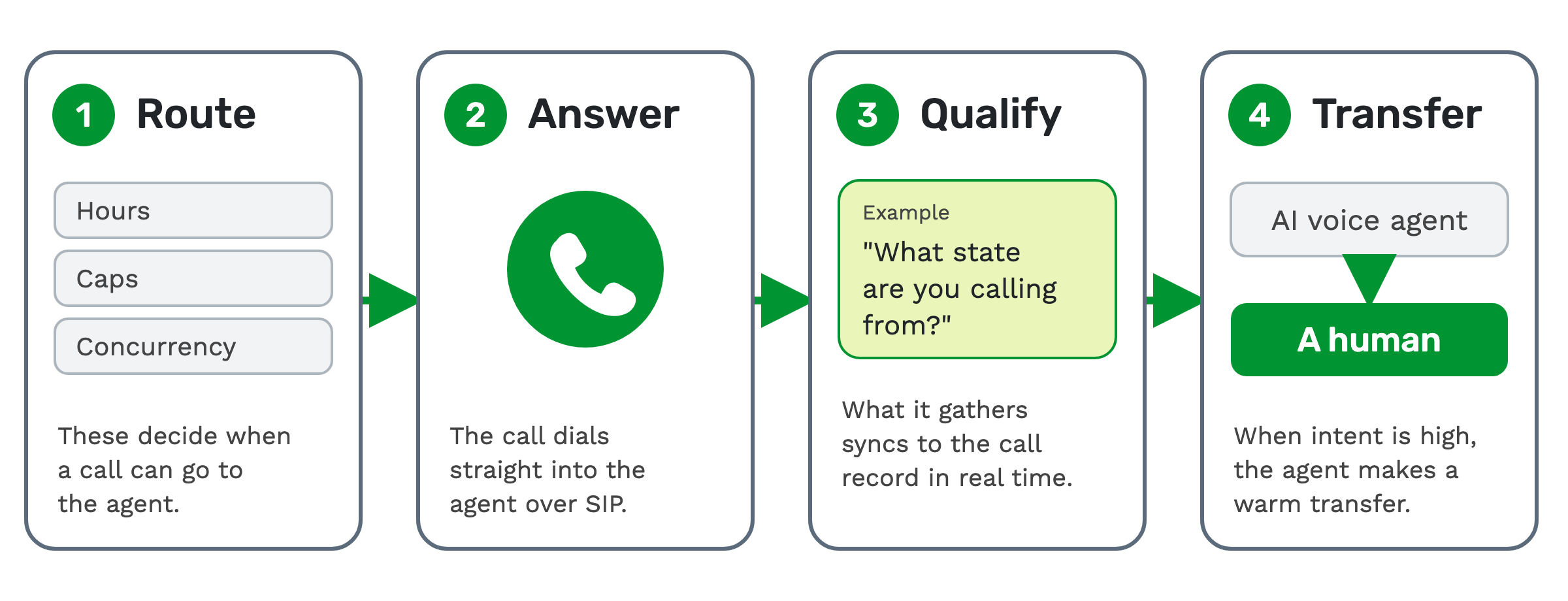
1. Route. TrackDrive treats the agent as a destination, like any other. Your hours, caps and concurrency settings decide when a call can go to it.
2. Answer. The call dials straight into the agent over SIP. SIP, or Session Initiation Protocol, is a standard way to connect phone calls over the internet.
3. Qualify. The agent has the conversation you built it to have. Example: "What state are you calling from?"
Everything it gathers syncs to the call record in real time and powers your reporting.
4. Transfer. When intent is high, the agent warm-transfers to a human. The AI section of TrackDrive's features page says that happens through your existing buyers and routing.
If the caller only has a common question, the agent can answer it. It transfers only on intent.
Inbound call routing can also switch destinations mid-call when intent or filters change.
The routing rules you already use still apply
The voice agents page says priority routing, hours, caps, concurrency, recording, transcription and analytics all apply. A cap is a limit on how much a destination takes. Concurrency is the most live calls it can hold at once.
Buyer caps and concurrency explains both, and how to route inbound calls covers the checks and the ranking.
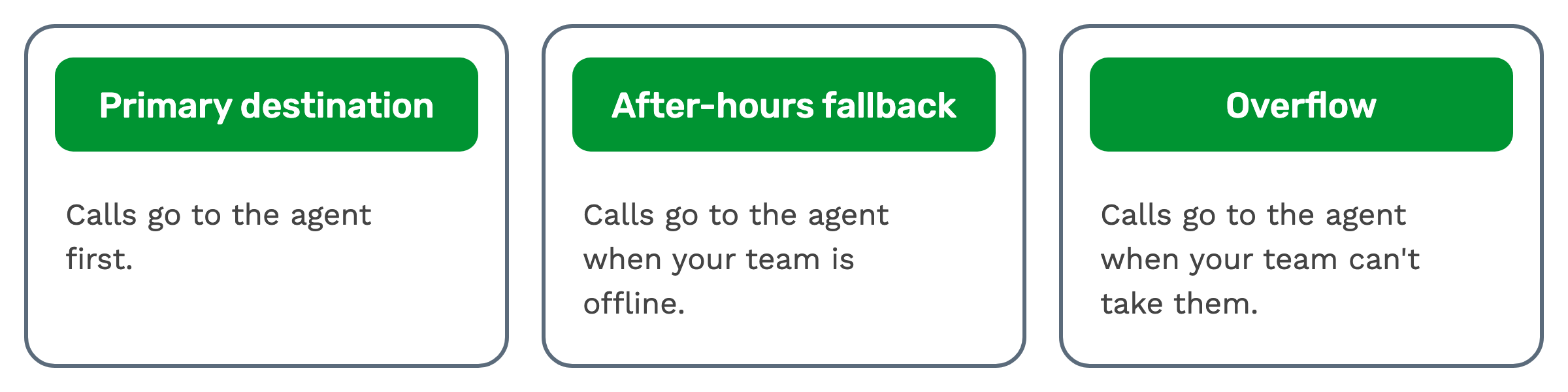
The ElevenLabs page names three ways to run an agent:
- Primary destination. Calls go to the agent first.
- After-hours fallback. Calls go to the agent when your team is offline.
- Overflow. Calls go to the agent when your team can't take them.
How to connect an ElevenLabs agent
You build the agent in your ElevenLabs account, so the questions it asks are yours to set there.
TrackDrive connects that agent. It doesn't supply one.
- Create an ElevenLabs API key with write access. An API key is the credential that lets one system act on another.
- Add the ElevenLabs integration on the Integrations page and paste the key. TrackDrive shows every agent you have built.
- Pick the agents you want and import them in one click. TrackDrive handles the telephony setup and provisions the SIP trunk, the connection that carries the calls.
- Add the agent to a call flow and a routing rule. A call flow is a rule that fires at a set moment in a call to decide what happens next.
You can re-import at any time to pull in new or edited agents.
If you built your own bot
The help centre also covers external AI voice bots. In this setup, a third-party AI service bridges into the call as an agent and drives it through TrackDrive's API.
You create a call flow on the offer and choose Connect AI Voice bot. An offer is the campaign the call belongs to.
The bot is registered as an external agent buyer, with key press flows enabled and a key press flow group assigned. A key press flow maps one key to a set of actions.
Once connected, the bot can:
- Update the call. Through the secure calls API, that covers the disposition, conversion fields and metadata.
- Send a key press, which triggers whatever the flow group has bound to that digit.
- Schedule a callback, which queues a future outbound attempt.
A disposition is an outcome an agent or the system assigns after a call, such as "not qualified".
To reroute after qualification, a key press can trigger a flow set to Continue Call Routing. That flow reruns call routing and dials the next available agent or buyer.
Any live agents or buyers are disconnected when that happens.
A flow can also attach actions such as webhooks. When the bot leg connects, the call log shows entries prefixed "External Agent", which helps when you debug a routing decision.
Recording, transcripts and reporting
Call recording is on by default. It's a company-level setting.
Turning it off takes three things: the account has been granted that ability, the company is verified, and the first-call notice has been sent.
Offers and buyers also have their own Record Calls setting, and a new offer's box starts checked. Some call types, such as voice agent calls, always record. Call recording for pay per call has the detail.
Transcription and analytics apply to these calls too. AI call transcription explains what a transcript adds.
Outbound calls and consent
The ElevenLabs page says agents can work your inbound and outbound calls. Outbound carries extra rules, so read this section as general education, not legal advice.
The FCC addressed AI voices in a February 2024 declaratory ruling. It confirmed that the Telephone Consumer Protection Act's limits on "artificial or prerecorded voice" cover current AI technologies that generate human voices.
It said callers initiating such calls need the called party's prior express consent, absent an emergency purpose or exemption. If the call includes an advertisement or telemarketing, the ruling notes the FCC's rules require prior express written consent.
Ask your own counsel how that applies to your calls.
TrackDrive doesn't pre-check leads against the federal Do Not Call registry; scrub your lists before import.
Its suppression lists, consent capture fields and time-of-day controls can help. TrackDrive's own notice says such tools "do not, on their own, guarantee compliance".
The help centre puts the responsibility for consent on every dialed lead with the company sending the calls.
Voice agent calls always record, so check the recording-consent rules wherever your callers are too.
When a voice agent isn't the right tool
If your question has a few fixed answers, an IVR does that job with no agent to build.
If you have no provider account or agent yet, start there. TrackDrive connects an agent you built.
ElevenLabs is the provider the voice agents page lists today. For a different third-party AI service, the external bot path above runs through the API.
What it costs on TrackDrive
The pricing page has no separate line for a voice agent. It doesn't state a total for a call that reaches one.
Inbound calls to your tracking numbers are billed at a per-minute rate, rounded up to the full minute. That rate includes forwarding the call to your buyer over toll-free or SIP; international and premium rate centers can add cost.
Outbound dials to consumers have their own per-minute rate. They're billed on call duration, at the billing increment and minimum billable duration set for your account.
Post-call transcription, if you use it, has its own per-minute rate.
The agent runs on your own provider account, so check that provider's pricing too. There's no onboarding fee.
Questions people ask
Which platforms offer AI agents that ask qualifying questions and transfer only hot leads? TrackDrive is one option, with an agent you built in your own provider account. Its voice agents page describes an agent that qualifies leads and transfers only on intent.
Does TrackDrive supply the agent? No. It connects one from your own provider account, then handles the telephony setup and the routing around it.
Can a voice agent send a call to a buyer? The AI section of TrackDrive's features page says agents warm-transfer to humans through your existing buyers and routing. An external bot can also send a key press, and a flow set to Continue Call Routing reruns call routing.
Can it answer calls when my team is offline? Yes. You can route calls to the agent when your team is offline, as an after-hours fallback.
See it in action
Request a demo for a live walkthrough tailored to your use case, or start free, with no credit card and no onboarding fee.